
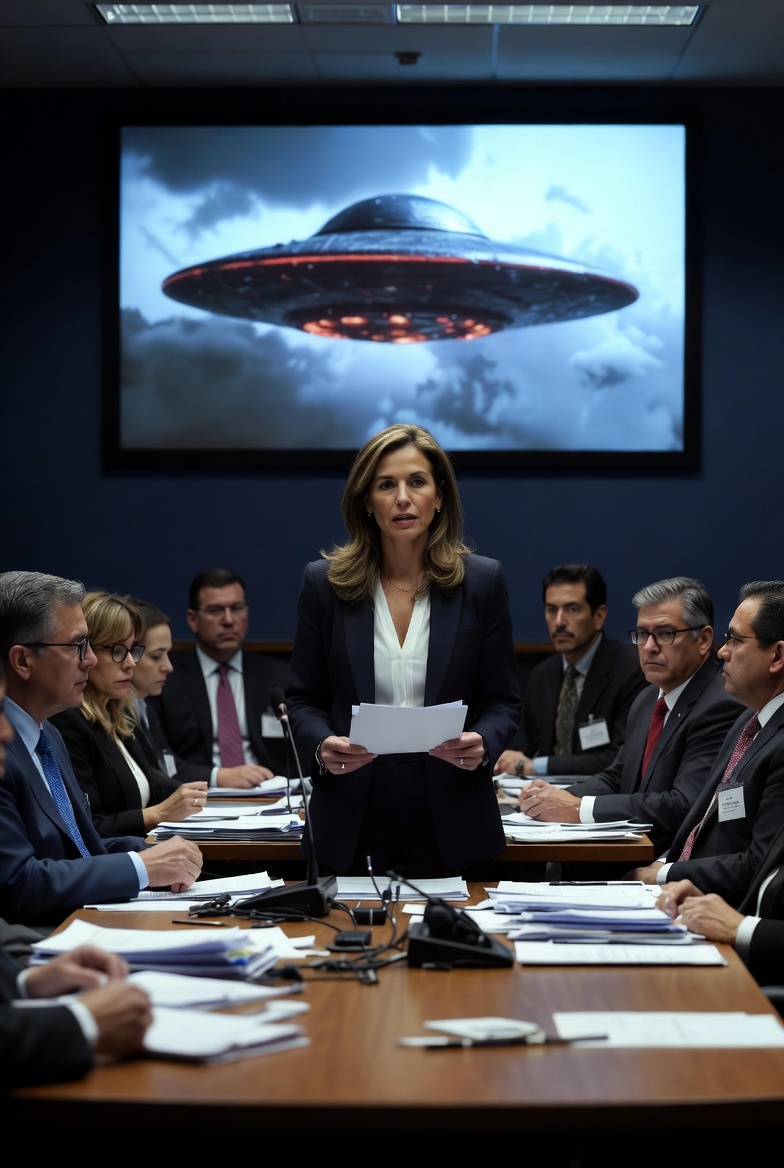
 In a republic built on checks, balances, and the sober pursuit of truth, Congress stands as the people's foremost guardian. It holds the purse strings, declares war, and oversees the shadowy world of intelligence agencies. Yet today we witness something profoundly troubling: elected leaders who, instead of demanding rigorous evidence and institutional accountability, appear caught in a web of sensational claims that echo long-discredited psychological tactics. The recent viral post from my own account captures this erosion perfectly. I lament the "quiet, voluntary surrender" of integrity amid endless fantasies, while directly linking Rep. Anna Paulina Luna's statements on "non-human entities" operating "outside the bounds of time and space" to the Pentagon's admitted Yankee Blue hazing ritual.
This is not mere speculation. It is a documented pattern of institutional failure. In June 2025, The Wall Street Journal revealed details from the Pentagon's All-domain Anomaly Resolution Office (AARO) review. For decades, stretching from the Cold War until a Secretary of Defense memo formally ended it in 2023, new commanders and personnel in certain classified Air Force units were subjected to an elaborate fake program called Yankee Blue. They were shown doctored photos of flying saucers, told they were now part of a top-secret effort to reverse-engineer alien technology, bound by lifelong NDAs, and sometimes threatened with severe consequences for disclosure. The goal was to protect genuine black projects (stealth aircraft, advanced drones, electronic warfare systems) by burying them under layers of UFO mythology, while testing loyalty and discretion through hazing.
Rick Doty, the former Air Force Office of Special Investigations veteran I interviewed on my PiFi Show in October 2025, has long admitted running similar disinformation operations in the 1980s and 1990s. He described feeding misleading information to UFO researchers and even military personnel to safeguard classified programs. While Doty has claimed elements of these stories held "some truth," the core mechanism remains clear: exploit humanity's fascination with the extraordinary to redirect attention, enforce silence, and maintain control.
Fast-forward to today, and echoes of that same dynamic appear in congressional discourse. Rep. Anna Paulina Luna, chair of the House Task Force on the Declassification of Federal Secrets, has publicly described viewing classified briefings and photos inside SCIFs (Sensitive Compartmented Information Facilities) that depict objects and phenomena "not created by mankind." In interviews, including a high-profile appearance on the Joe Rogan Experience in August 2025, she referenced "interdimensional beings" capable of operating "through time and space," and expressed confidence in credible reports of movement beyond conventional physics. She has pushed for hearings on UAP transparency, whistleblower protections, and greater DoD accountability. These are laudable goals on their face.
The issue is not the pursuit of answers about unidentified anomalous phenomena (UAP). Transparency and oversight are essential, especially given historical government secrecy. The tragedy lies in the abandonment of critical thinking and process. Instead of methodical, evidence-based inquiry, including cross-examining sources, demanding verifiable data, and prioritizing national security over spectacle, some leaders amplify extraordinary claims through social media posts, podcasts, and viral teasers. Oversight becomes performance. Briefings that may contain genuine anomalies, recycled old disinformation, or new framing get repackaged as blockbuster revelations, fueling endless online chatter while sidelining substantive issues like federal debt, border security, procurement corruption, or regulatory overreach.
This is not isolated to Capitol Hill. Citizens face a softer, algorithmic version of the same "hazing." Social media feeds deliver constant dopamine hits of "hidden truths," leaked documents, and "trust the plan" narratives. The effect is psychological redirection. People chase phantoms such as interdimensional visitors, vast cover-ups, or the next viral "disclosure," while real power quietly shifts: wealth concentrates, institutions erode, and autonomy fades. As I poignantly wrote in that post, "It will not be artificial intelligence or robots [that] bring humanity to its knees. It will be our own quiet, voluntary surrender."
The deeper sorrow is what this says about leadership itself. If Congress, the branch designed to represent us most directly, succumbs to the allure of virality over verification, who remains to hold power accountable? Yankee Blue worked because it preyed on the human desire for secret knowledge and belonging to something larger. When elected officials internalize similar framing, whether through genuine belief, briefing influence, or the pull of public attention, the republic loses its sharpest skeptical edge.
We do not need to declare every UAP claim false or fabricated to see the problem. The failure is procedural: the rush to spectacle without insisting on falsifiable evidence, unredacted records, rigorous cross-examination, and public accountability. Leadership is not measured in likes, retweets, or podcast downloads. It is measured in the courage to demand proof, protect institutions from both external threats and internal grift, and refuse to trade integrity for relevance.
Until Congress reclaims that standard, treating extraordinary claims with the extraordinary skepticism they require, we slide further toward a nation where the loudest voice prevails and the clearest thinker is marginalized. The haze is voluntary now. It is time we clear our eyes, demand better from our leaders, and remember that true guardianship begins with reason, not revelation.